Finding Stillness in Motion: How I Use Intentional Camera Movement
When people first encounter my photographs, they often ask how I made them.
The shortest answer is that I move the camera while the shutter is open. This makes the process sound suspiciously easy. If all it required were a quick wobble, every accidental blur would be a masterpiece and photographers could all go home early.
Intentional camera movement, or ICM, is more deliberate than that. It brings together observation, movement, timing and a willingness to relinquish some control. I use it to make photographs that describe not only how a landscape looked, but how it felt to be there.
When sharpness stopped being the point
Photography traditionally teaches us to keep the camera still. We learn to pursue sharpness, preserve detail and record the world as clearly as possible.
I still care about light, composition and structure, but eventually I realised that clarity was not always what I wanted from a landscape photograph.
A sharply rendered mountain could show its rock, scale and contours beautifully while leaving out the sensation I remembered: cloud moving across its face, rain gathering in the distance or light appearing briefly before the weather closed again.
I wanted the hills to carry movement. I wanted trees to feel as though they were emerging from memory. I wanted water, mist and land to slip into one another.
ICM gave me permission to stop asking whether a photograph was sharp enough and begin asking whether it felt true.
The landscape sets the direction
I do not arrive with one camera movement that I apply to every subject. I begin by looking for the underlying structure of the place.
A horizon may suggest a slow horizontal movement. A stand of trees might call for something vertical. The rise of a hill can lead the camera through an arc, while a small diagonal movement might follow the direction of rain, light or a distant slope.
During the exposure, I move the camera while paying attention to the speed, direction and quality of that movement. Even very small changes can produce entirely different results.
The movement must respond to what is already present. My intention is not to impose an abstract effect on the landscape, but to find a gesture that belongs to it.
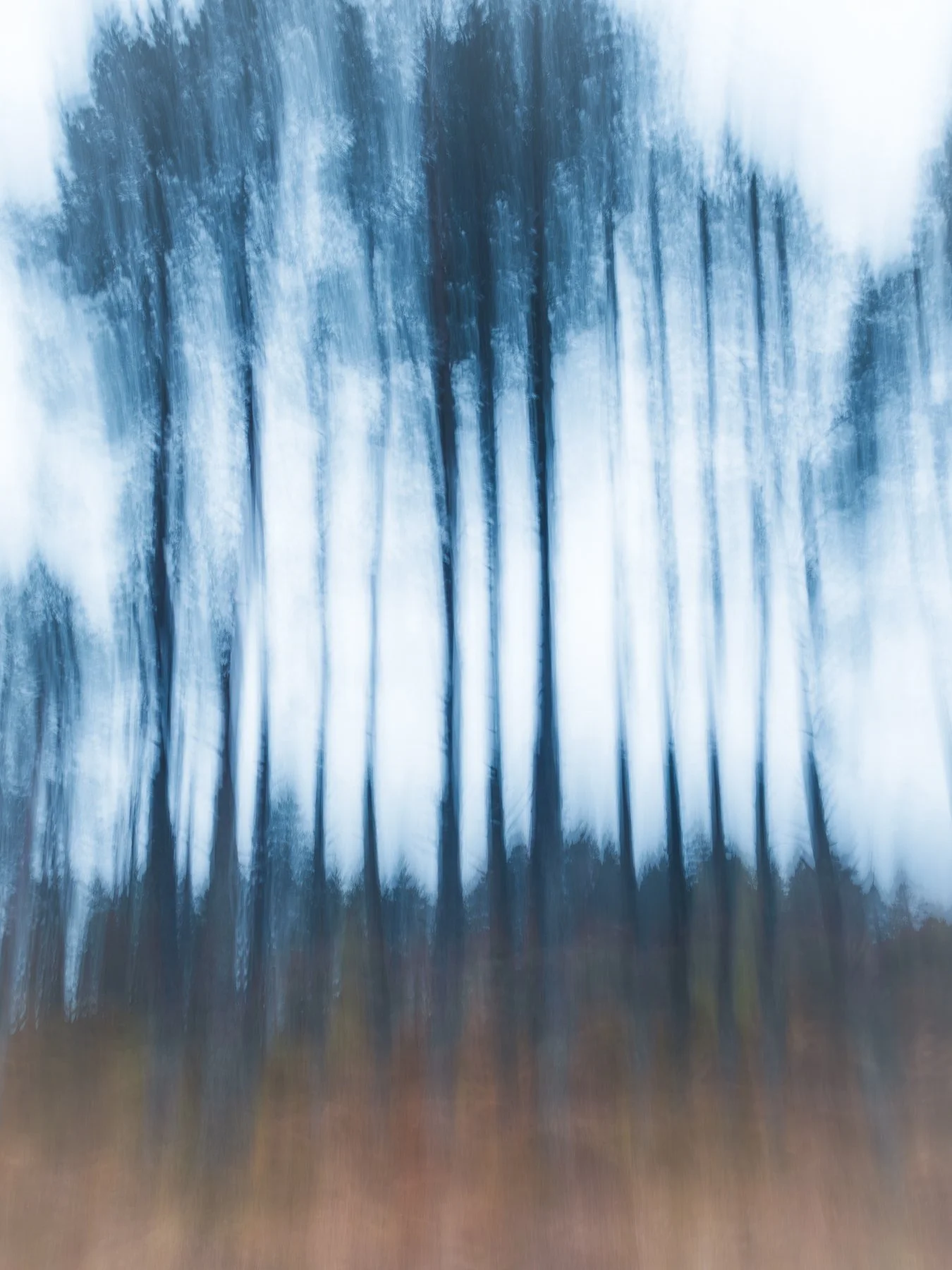
Where the Pines Remember, from Transference - Torridon & Wester Ross
Control, surrender and a great many failed frames
ICM sits somewhere between control and uncertainty.
I choose the subject, framing, exposure and movement. What I cannot completely predict is how those decisions will combine with the available light, changing weather and forms within the scene.
Some frames are simply blurred. Others lose too much structure or feel overly deliberate. Occasionally, movement, colour, light and emotion settle into the same photograph.
That unpredictability is part of the process rather than an unfortunate side effect. I may make hundreds of exposures while changing the movement by only a fraction. The unsuccessful frames help me understand what the landscape will tolerate before it disappears completely.
ICM is not a filter applied afterwards. The abstraction is created in the camera, at the moment of exposure, through a physical response to the place in front of me.
Editing for what remains
I rarely know with certainty which photographs have succeeded while I am making them.
Later, with some distance from the experience, I look for images that hold more than an attractive arrangement of colour. I want a photograph to retain enough of the landscape for the viewer to enter it, but enough ambiguity for memory and imagination to become involved.
The strongest image is not necessarily the loudest or most immediately impressive. It may be the one that keeps drawing me back without explaining itself completely.
I look for rhythm, balance and emotional recognition. There is often a particular frame in which the movement feels inevitable, as though the landscape had briefly revealed the form it wanted to take.
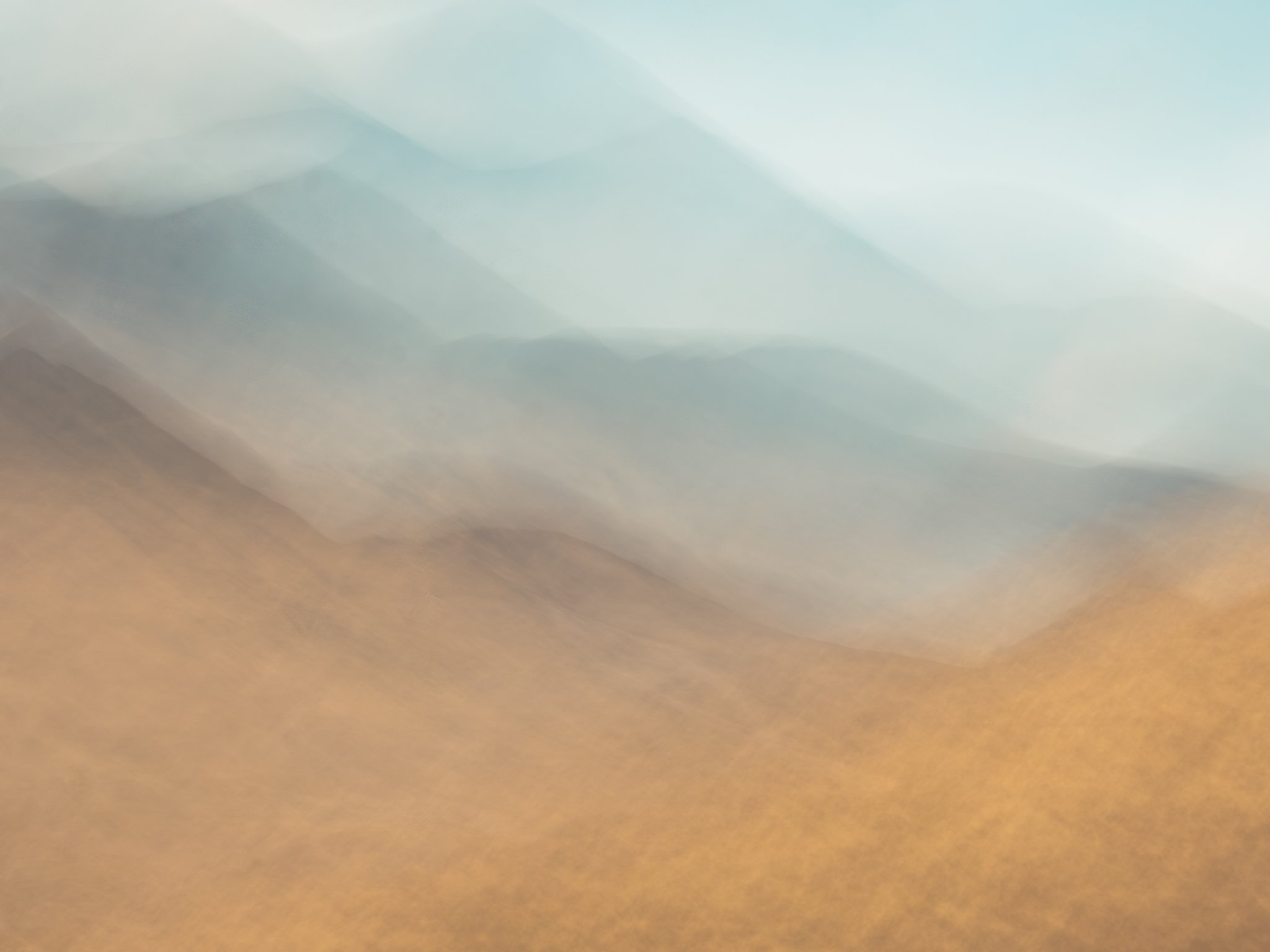
Daylight Crosses, from Transference - Torridon & Wester Ross
Why Scotland suits this way of working
Scotland is rarely still, even when the geology suggests otherwise.
Weather moves through the landscape quickly. Hills appear and vanish behind cloud. Light travels across a loch and is gone before there is time to become accustomed to it. On Harris and Lewis, sea, sky and land continually rearrange themselves. In Torridon and Wester Ross, ancient mountains seem to shift as rain, mist and changing light move across them.
ICM feels less like adding movement to these places than responding to movement already present.
Because I was born in Edinburgh and now live in Jersey City, photographing Scotland also involves memory, distance and return. I am looking at the landscape in front of me while carrying other versions of it - the Scotland I remember, the one I miss and the one that has continued changing without me.
The softened detail of ICM allows those experiences to coexist. The landscape remains real and geographically specific, but the photograph can also hold longing, uncertainty and recognition.
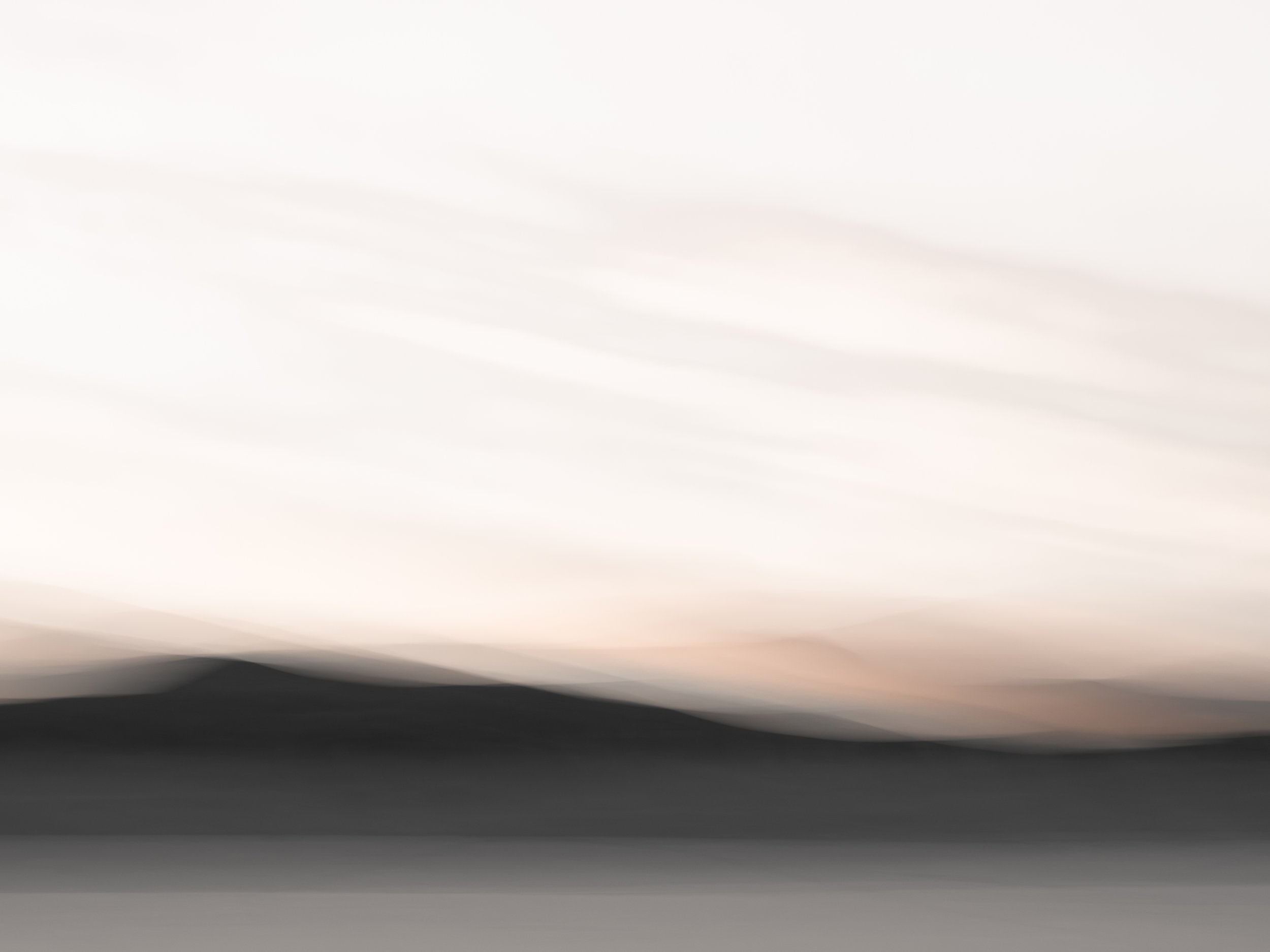
Quiet Flame, from The Gloaming - Harris & Lewis
From exposure to finished work
The photograph is not finished when it appears on a screen. Printing gives the image scale, surface and physical presence.
Some of my limited-edition works are produced on canvas and finished in floating frames, available through Novado Gallery. Their larger scale allows the viewer to feel surrounded by the movement and atmosphere within the image.
For The Gloaming open-edition collection, I chose Hahnemühle German Etching paper. Its softly textured surface suits the collection’s restrained colour, mist and quiet transitions, while the 20 × 16 inch format makes the work intimate enough to live with easily.
The material changes according to what each body of work needs, but the intention remains the same: to make atmosphere physical and give the photograph a life beyond the screen.
The stillness inside the movement
The apparent contradiction of ICM is that I use movement to create stillness.
The camera moves, the landscape softens and unnecessary detail falls away. What remains can feel quieter than the original scene.
I hope these photographs offer a place for the eye to rest and for the viewer’s own memories to enter. Someone may recognise a Scottish ridge or shoreline. Someone else may be reminded of a completely different landscape, a particular kind of weather or the feeling of standing somewhere they have never quite forgotten.
The photograph begins with my experience of a place, but it does not have to end there.